
Sugar gliders, ฿750–1,400 by colour — with the diet we actually use
More pet sugar gliders die from too little calcium than from being "hard to keep". So we don't send you home to guess. Before you take one, we give you the exact feeding routine our farm uses, and you can ask us anything afterwards.
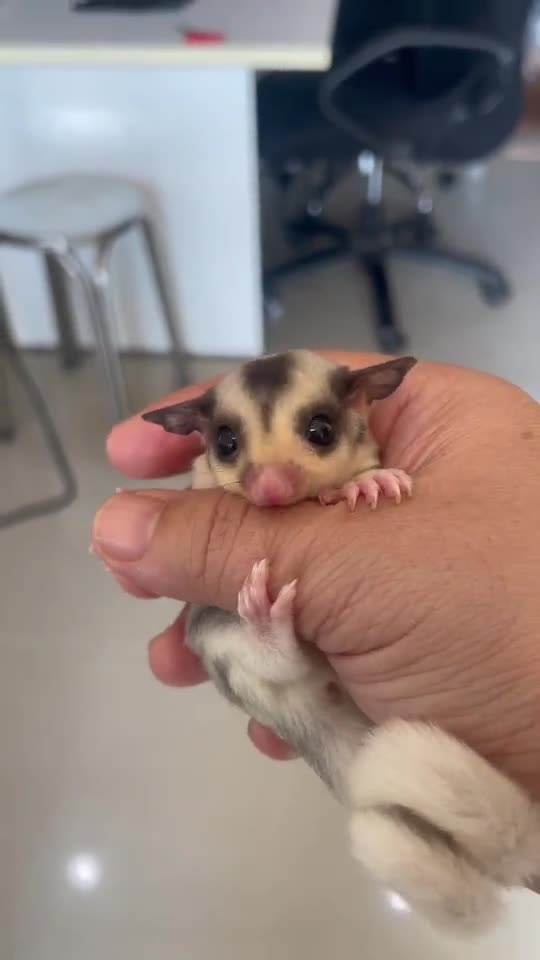
What sugar gliders eat
The proportions matter more than the ingredients. This is what our farm does, checked against the MSD Veterinary Manual and published nutrition studies.
Complete pellets — the base of every meal
Our farm builds every meal on a commercial glider pellet. The veterinary manual puts insects plus pellets at close to half of the whole diet. A study that tested three popular home-made recipes found they were about 90% digestible, but none of them had balanced minerals — so a home-made mix on its own is not a safe staple.
Fruit and vegetables — no more than 10%
We give small pieces of Nam Wa banana, apple and cantaloupe, rotated. The manual says fruit, nuts and vegetables together should stay under 10% of the diet: they lack protein and minerals, and a lot of fruit also causes gum and tooth disease.
Protein — always gut-loaded first
Mealworms, crickets, boiled egg. Too little protein and the animal gets thin with a poor coat. The key point from the manual: use calcium-loaded insects only. A plain mealworm has a calcium-to-phosphorus ratio of just 0.07 — badly inverted. After 48 hours of gut-loading it rises to 1.31. Feeding plain mealworms as the main protein makes the calcium problem worse, not better.
Calcium — the mistake people make most
A fruit-only diet leads to metabolic bone disease (MBD): it starts as weak back legs and progresses to paralysis. Calcium must be supplemented every day, but dusting powder over an unbalanced diet does not fix it — the calcium-to-phosphorus ratio and vitamin D3 have to be right too. Severe spinal deformity may not be reversible.
Avoid: chocolate, caffeine, onion, garlic, fruit seeds and pits, spicy or fried food, and any human snacks. High-oxalate foods (strawberries, raspberries, pears, spinach, carrots) are fine occasionally but not often — they block calcium absorption.
Four things to have ready
A tall cage
Gliders climb and glide — height matters more than width. Bar spacing must be narrow enough that they cannot squeeze through.
A sleeping pouch
They are nocturnal. During the day they need a dark, warm place to sleep. Not optional.
Calcium supplement from day one
Have it ready before the animal arrives, not later. MBD builds up quietly before you see any sign.
Your time: 30–60 minutes a day
At minimum. If you can't give that, keep a pair so the animal has company.
What's good about gliders — and what you must accept
Both sides before you decide. The things owners genuinely love, and the things sellers often don't mention — especially the smell.
They bond with you — by scent
In the wild gliders live in groups of 5–12 and mark group members with scent glands to say "you're one of us" (MSD). That's why owners put a cloth carrying their own smell in the sleeping pouch, and why a glider that knows you runs to you: you've become part of the group in a world ruled by smell. That they can tell their owner from strangers is something owners agree on, but we haven't found a study that tested it directly in gliders — so we call it an observation, not a result.
They live a long time
MSD gives a captive lifespan of 4–15 years, far longer than a hamster. That wide range isn't luck: the ones that reach the top end are the ones fed correctly with enough calcium all along. The ones that die early usually die of bone disease that built up silently for months. Whether you get 4 or 15 is largely up to the owner.
They smell — strongly
Both sexes have scent glands beside the cloaca; males also have glands on the forehead, throat and chest (MSD). This musky smell is normal for the species — not dirt, not bad care — and no amount of cleaning removes it permanently, because it's how they communicate. Males are usually stronger than females. If you or anyone in your home is sensitive to smells, come and meet one in person first. We're always happy to arrange that.
Nocturnal and social
MSD notes they're so nocturnal that vets are advised to book exams in the morning, when the animal is least active. Their most active hours are when you're going to bed. More importantly, they do better in pairs or small groups; a single glider needs a lot of your time and enrichment to avoid stress and self-mutilation. If you know you're too busy to play every day, take a pair — or wait.
Why gliders nip your hand — and how to fix it
A nip is rarely aggression. Usually it's communication or investigation. Understand the reason and you can fix it without forcing the animal.
1. Your hand doesn't smell like the group
Gliders judge the world by scent (MSD). A hand that just touched another animal, has lotion on it, or belongs to a stranger is a "foreign object" to be investigated — and a small animal investigates with its mouth. What we do: put a cloth with your smell in the pouch so they get used to you first, and wash your hands before every handling, especially after touching food. Common practice among keepers; we haven't found a study testing it directly.
2. You woke it up
Reaching into the pouch in the daytime is like being shaken awake at 3 a.m. A defensive reaction is normal, not bad temper. Fix: play in the evening and at night, when it's awake on its own.
3. It lives alone and is bored
MSD says gliders do better in pairs or small groups; a lone glider needs a lot of time and activity to avoid stress and self-mutilation. A stressed animal reacts to everything, including your hand. Fix: if it's alone, give real time every day — or get a pair.
4. It's in pain — this one is urgent
If a calm glider suddenly starts nipping, don't assume its personality changed. Animals in pain defend themselves more, and the most common disease in pet gliders is calcium-deficiency bone disease, which hurts and makes bones fracture easily. MSD also notes that soft, sweet food causes gum and tooth disease — a sore mouth bites too. New nipping plus weak back legs, tremors, limping or not eating → exotic-pet vet, now.
Glider colours — what's known, and what's just trade talk
Price depends on colour, so we think you should know where the colour information comes from.
Read this first — colour genetics has no published research behind it
We searched the veterinary manuals and journals and found no source describing the genetics of sugar glider colours. Everything circulating about Whiteface, Leucistic, Mosaic and Platinum comes from breeder communities, not from science. So we describe colours below as market names you can check by eye — we make no claim about how they're inherited. If someone tells you "this gene is definitely dominant over that one", ask for a source.
What IS backed by research: gliders see colour and ultraviolet light. Nielsen et al. (Scientific Reports, 2025) tested behaviour, genetics and eye tissue and found trichromatic colour vision plus UV sensitivity — unusual for a nocturnal animal. The world your glider sees is not the one you see.
Colour doesn't change care. Every colour needs the same diet, the same calcium, the same company. We found no research linking colour to health problems in gliders — and to be complete, no research showing there are none either. Our rule: we don't breed for colour at the expense of health, and we answer honestly about parents every time we're asked.
| Market name | What you can see |
|---|---|
| Standard / Classic Grey (Thai: นอร์มอล) | The wild-type grey: dark stripe from head to tail down the back, dark markings on the face. |
| Whiteface | Like standard, but without the dark bar under the ear, so the face looks cleaner. Back stripe intact. |
| Mosaic | Irregular white patches — no two animals alike. Some are white only on the face; some are almost entirely white with a faint pattern left on the head. |
| Leucistic | All white, black eyes, back stripe gone. |
| Albino | All white too, but red eyes — no pigment at all. Eye colour is how you tell it from leucistic. |
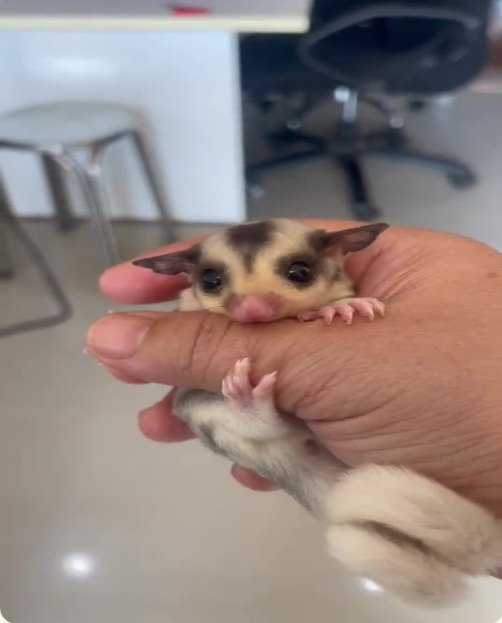
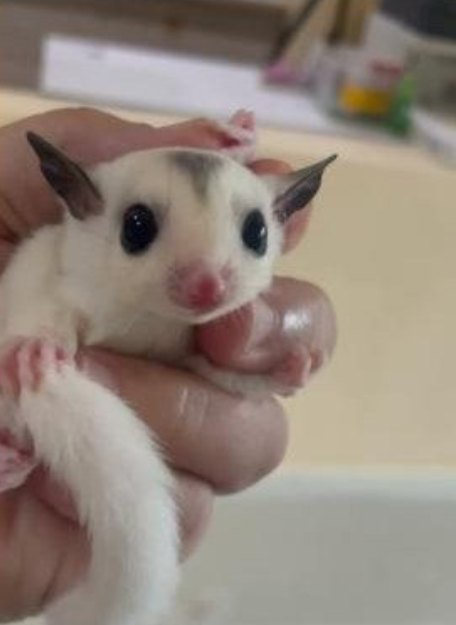
Both photos are our own animals, not pulled from the internet. Every animal we offer is photographed fresh for you before you decide — ask for a video any time.
Thinking of breeding? Know this first
Every number here is from the veterinary manual, not from keeper-group folklore.
Age at sexual maturity (MSD)
"Can" and "should" are different things. A female that isn't fully grown and hasn't had enough calcium will have pregnancy and nursing pull calcium out of her — in a species already prone to bone disease. Get diet and calcium stable first, then think about joeys.
Timeline from mating to weaning (MSD)
- Gestation15–17 days — very short, because they're marsupials; the joey finishes developing in the pouch
- Out of pouchabout 60 days (range 50–74)
- Weanedabout 100 days (range 85–120)
- Litter size2 joeys in 81% of litters
Mating to weaned joeys: roughly 4 months.
Group structure — and when to separate joeys
MSD recommends groups of one male with several females. Critical for breeders: separate joeys as soon as they're weaned to avoid violent eviction — in the wild, grown young must leave the group, and in a shared cage that turns into fighting. Leaving them together because "it's a cute family" is the misunderstanding that gets joeys hurt.
If you don't want joeys
MSD notes that neutering males is a routine procedure in gliders, used to prevent breeding and reduce sexual stress. Spaying females is uncommon because their anatomy makes surgery much harder. If you keep a male–female pair and aren't ready to breed, talk to an exotic-pet vet before deciding. Don't use permanent separate cages as the answer — a glider kept alone gets stressed and self-mutilates.
How you get your glider
Bangkok, near Central Rama 2
Our gliders are kept in Bangkok. We agree a day and time by message or phone. No extra charge.
None — in person only
Gliders are small and stress badly on long journeys, so we only hand them over face to face. We don't ship within Thailand and we don't export.
Bank transfer or PromptPay
No deposit before you've seen the real animal. We send photos, video and the total for you to confirm before we meet.
Take your time
See and hold the animal, ask everything about feeding and care. If it's not right for you, don't take it — there's no deposit to lose.
Questions people ask most
How much is a sugar glider?
฿750–1,400 per animal depending on colour and pattern. Standard grey is at the low end; rarer colours cost more. Message us any day to ask what's available right now — we always send photos and video of the actual animal first.
Can I see one before deciding?
Yes. Our gliders are in Bangkok — we meet you there, near Central Rama 2. The farm in Ubon Ratchathani is home to the plants and tortoises; there are no gliders at the farm.
Do you ship? Can I buy from outside Thailand?
No shipping, no export. Handover is in person in Bangkok only. If you live in Thailand and can get to Bangkok, we can help you. If you're abroad, we're sorry — we can't.
What do they eat?
Proportions matter more than ingredients: a complete pellet plus calcium-loaded insects as the base; fruit and veg under 10%; calcium every day. Full details in the feeding section above.
Is it legal to keep one in Thailand?
See the legal note above. Sugar gliders are not CITES-listed and we found no evidence they need a possession notification, but the list changes — please check with DNP directly. Our summary of CITES CoP20 and Thai law is on our Thai news page.
Can I buy plants or a tortoise at the same time?
Plants and tortoises are at the farm in Ubon Ratchathani. Plants can be sent by parcel anywhere in Thailand; tortoises are handed over in person in Ubon or Bangkok. See what we grow.
Ask what's available now
- Facebook Messenger — fastest, English OK
- +66 94 731 3117 — daily 08:00–18:00 Thai time (Thai on the phone; for English, message)